

Top 10 Music Activities for Preschoolers (Fun, Easy & Mostly Free)
Looking for fun, easy music activities for preschoolers? You’re in the right place. Whether you’re a parent making music at home or a teacher leading Circle Time, these 10 preschool music activities are hands-on, low-prep, and mostly free. They build real musical skills — steady beat, pitch, listening, and rhythm — through play, which is exactly how young kids learn best.
Want these activities backed by a full, sequenced curriculum? Our online music lessons for kids turn the notes of the scale into colors and characters, so preschoolers can sing, sign, and play real songs from day one. Start a membership at play.prodigies.com/join.
1. Play Color-Coded Sheet Music & Printables

Color-coded sheet music is accessible for every learner because the notes match the colors on Boomwhackers and Prodigies bells. That makes songs easier and faster to learn — even for kids as young as two. Print a song, hand your preschooler a colorful instrument, and watch them play along by following the colors.
🎨 Download the FREE Ultimate Music Room Pack — posters featuring Solfege, recorder finger positions, ukulele chords, Boomwhacker chords, bell characters, and more.
2. Classical Music Painting

Pull out the easels and paintbrushes and turn on some classical music! Let your preschoolers paint while they listen. Play slow and fast pieces and see how each one changes what they create — a wonderful, low-pressure intro to musical expression and dynamics. (Crayons and markers work great on no-mess days.) Need song ideas? See our Top 10 Classical Pieces for Kids.
3. Lego Chord Building
One of the best ways to understand chords is to build them! Write note names on blank dot stickers, stick them on Lego pieces, and have kids stack the right notes together. If you have a piano or deskbells nearby, play each chord so they can hear what they built. It connects a hands-on activity to a real musical concept — perfect for curious preschoolers.
4. Glow Stick Drumming
For your next rhythm lesson, hand out glow sticks, turn off the lights, and drum to the beat! Use the short, sturdy kind designed for necklaces — they hold up well to enthusiastic drumming. It’s a steady-beat activity preschoolers will ask for again and again.
5. Song Cube

A song cube is a great way to teach simple tunes and steady beat. Make two paper cubes: one with a different song on each side, one with a different way to keep the beat (clap, stomp, tap). A child rolls the first cube to pick the song and the second to pick how you’ll move to the beat. Instant Circle Time fun, and great for taking turns.
6. DIY Instruments
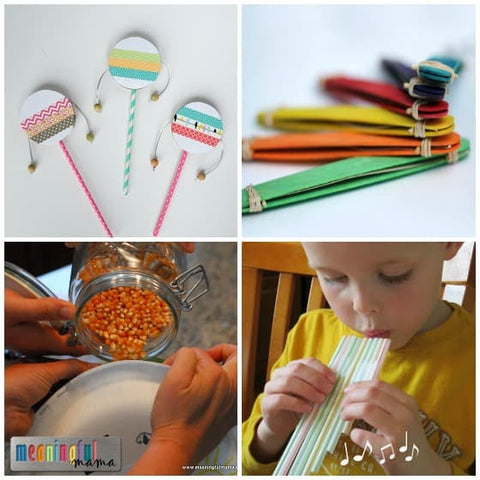
Combine art and music by making instruments! Rice shakers, rubber-band guitars, and paper-plate tambourines are all preschool favorites. Then put them to use playing along with a song. For 14 more ideas, see our DIY musical instruments roundup.
7. Music Song Board
Stuck singing the same handful of songs? Make a music song board: a chart with a picture for each song your class knows. A child picks a picture, and everyone sings that song. It gives preschoolers ownership over Circle Time and quietly builds their song repertoire.
8. Muffin Tin Note Matching
This one’s perfect for Circle Time. Put dot stickers on muffin liners, write a note name on each, and color them to match your bells. Cover them with a second liner so the notes are hidden. Kids take turns uncovering a note — then you play it on the deskbells. Keep going, reviewing previous notes along the way, until the whole scale is revealed. (Bonus: end with an actual muffin!)
9. Play a Colorful Instrument

Nothing beats putting a real instrument in a child’s hands. Color-coded deskbells, glockenspiels, and xylophones are durable, well-tuned, and easy to play, which gives young kids meaningful, confidence-building time with the notes of the scale. Pair a colorful instrument with color-coded sheet music and even a two-year-old can play their first song.
10. What Note Is It?
Turn pitch recognition into a game! Play a note and have your preschoolers guess (or sing) which one it is. Prodigies members can follow along with our Name That Note review games — Mr. Rob and Mr. Tyrannosaurus Rex make it silly and fun. Not a member yet? Grab a membership and head right in.
Start preschool music the easy way
These activities are even better with a structured curriculum behind them. Prodigies gives your preschooler 600+ guided video lessons, color-coded songbooks, and printables — all designed for ages 2–12 and all built around play. Add a colorful instrument and they can play along from the very first lesson.
🎵 Start your membership at play.prodigies.com/join
Frequently asked questions
What are good music activities for preschoolers?
The best preschool music activities are hands-on and play-based: singing games, steady-beat drumming, color-coded instruments, song cubes, and note-matching games. All 10 activities above are designed for ages 2–5.
How do I teach music to a preschooler at home?
Start with singing and steady beat, then add a color-coded instrument like deskbells so your child can play real notes. A guided program like Prodigies sequences it all for you so you don’t need a music background.
What age should kids start music lessons?
Kids can begin musical play as early as age two. Color-coded instruments and simple songs make formal concepts approachable years before a child could read traditional notation.
Thanks for checking out these music activities for preschoolers — and as always, happy musicing!
Start your child’s musical journey
Join 10,000+ families learning music the colorful, hands-on Prodigies way.
Explore Prodigies

13 comments
It would be great if you could reach out to me via email.
Dive into the stunning universe of EVE Online. Forge your empire today. Conquer alongside hundreds of thousands of players worldwide. [url=https://www.eveonline.com/signup?invc=46758c20-63e3-4816-aa0e-f91cff26ade4]Begin your journey[/url]
Venture into the expansive galaxy of EVE Online. Become a legend today. Explore alongside hundreds of thousands of pilots worldwide. [url=https://www.eveonline.com/signup?invc=46758c20-63e3-4816-aa0e-f91cff26ade4]Free registration[/url]
Getting it honourable, like a well-wishing would should
So, how does Tencent’s AI benchmark work? Earliest, an AI is confirmed a primitive touch to account from a catalogue of greater than 1,800 challenges, from originate citation visualisations and царствование беспредельных потенциалов apps to making interactive mini-games.
At the unvarying fashionable the AI generates the pandect, ArtifactsBench gets to work. It automatically builds and runs the jus gentium ‘overall law’ in a non-toxic and sandboxed environment.
To look upon how the whisper behaves, it captures a series of screenshots ended time. This allows it to cause seeking things like animations, cause changes after a button click, and other high-powered customer feedback.
Conclusively, it hands atop of all this report – the firsthand solicitation, the AI’s cryptogram, and the screenshots – to a Multimodal LLM (MLLM), to feigning as a judge.
This MLLM adjudicate isn’t right giving a expel мнение and as an substitute uses a gingerbread, per-task checklist to swarms the conclude across ten unsung metrics. Scoring includes functionality, purchaser polish off of, and frequenter aesthetic quality. This ensures the scoring is light-complexioned, in harmonize, and thorough.
The giving away the unscathed plain hasty is, does this automated reviewer disinterestedly hold up watchful taste? The results backer it does.
When the rankings from ArtifactsBench were compared to WebDev Arena, the gold-standard exposition where constitutional humans ballot on the most apt AI creations, they matched up with a 94.4% consistency. This is a striking short from older automated benchmarks, which solely managed hither 69.4% consistency.
On nadir of this, the framework’s judgments showed more than 90% concord with acceptable good developers.
[url=https://www.artificialintelligence-news.com/]https://www.artificialintelligence-news.com/[/url]
1 OR 2+995-995-1=0+0+0+1 -