

What Is the Kodály Method? A Teacher's Guide
Hungarian composer and educator Zoltán Kodály created his ingenious teaching method nearly 100 years ago. His approach emphasized collaboration, expressiveness, and creativity, putting instrument skills and theory on the back burner. Today it's one of the most popular ways to introduce young children to music.
What is the Kodály method?
In a Kodály classroom, children use their own voices as the primary instrument. They learn the “do-re-mi” (solfege) system — classically with a movable do, where “do” shifts to match the key.
At Prodigies we tend to use fixed do to help young children develop a sense of absolute pitch, but Kodály is famous for movable do, where the tonic (scale degree 1) is always do. Both are valuable — and we've added many movable-do songs to our catalog because we know how important it is to music teachers.
Students also develop natural rhythm, “organic collaboration” with classmates, and spontaneous creativity as a way of expressing themselves musically.
The 5 basic Kodály principles
- Music education matters early. Kodály believed very young children are the most adept music learners — he joked the best time to start is “nine months before birth.”
- Teach in a logical sequence. The curriculum is carefully structured so each lesson builds on the last.
- Make it fun. Classes have an upbeat, joyful atmosphere, so kids look forward to learning.
- The voice is the central instrument. Before any instrument, students learn to find notes and melodies with their voices.
- Teach through folk songs. Folk songs are ideal “basic” pieces that build listening, memory, and creativity.
Advantages of the Kodály approach
Its biggest strength is engaging all the senses. Kindergartners feel the pulse, hear the pitch, and sing along — noticing that different people make different sounds and that pulse is a physical part of music. They play simple instruments while learning nursery tunes and folk songs, instinctively absorbing dynamics, style, pitch, mood, tempo, rhythm, and form.
Later, students add hand signs, rhythm names, and the do-re-mi system. Collaboration is core — classes sing in rounds, perform duets, and sing together like a choir — and concepts are always introduced in a deliberate order so no one is left behind.
Kodály for all ages
Kodály isn't about “perfect pitch.” It centers relative pitch, improvisation, and rhythm, and adapts to any age or ability — from two-year-olds to adult beginners and working musicians.
Using Kodály ideas with Prodigies
At Prodigies, we blend Kodály principles (solfege, hand signs, folk songs, sequencing) with our color-coded approach to build a well-rounded curriculum for kids of all ages. If you teach general music, our elementary music curriculum is sequenced and standards-aligned, and pairs with color-coded bells and glockenspiels for hands-on play.
Aligning Kodály-based lessons to your state standards? Try our free tool, Pretty Standard Really — paste a lesson plan and see every PK–5 standard it hits. 🎵 Explore the curriculum → play.prodigies.com/join
Frequently asked questions
What is the Kodály method in simple terms?
A voice-first approach to music education that teaches pitch, rhythm, and notation through singing, solfege hand signs, and folk songs, in a carefully sequenced order.
What's the difference between Kodály and Orff?
Kodály is voice- and solfege-centered; the Orff method centers play, movement, and percussion instruments. Many teachers blend both.
What age can children start Kodály?
As early as age two. The method scales from preschool through adulthood.
Start your child’s musical journey
Join 10,000+ families learning music the colorful, hands-on Prodigies way.
Explore Prodigies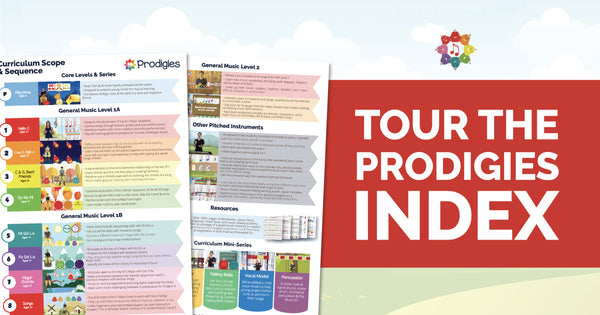
3 comments
In response to previous comment…
Pulse and rhythm are actually two different ideas :)
Rhythms refers to the beats that are performed. They may be consistent or inconsistent being made up of a variety of note values such as whole notes, quarter notes, eighth notes, etc. Pulse refers to the underlying steady tempo.
When they say to “Feel the pulse” they mean ot tap your foot or pat your leg or something to reinforce that underlying tempo or pulse as you perform. This helps to make sure students are staying “in time” with the music and helps larger groups to stay together with one another and with the music.
Hope this helps!
u guys r funny, “feel the musical pulse” u mean the rhythm? 😂 I’m not even gonna get into anything else
1