
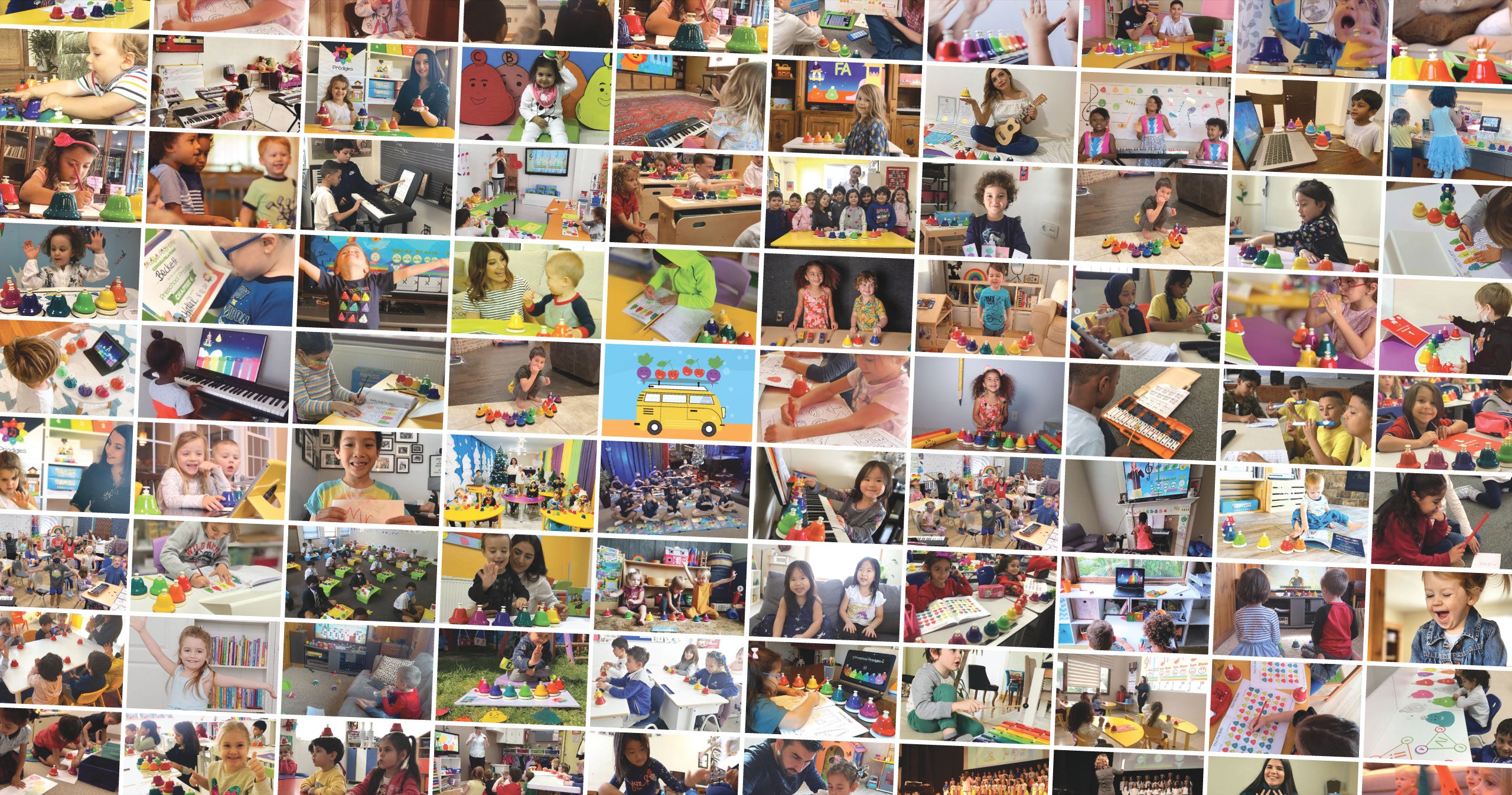
Prodigies Works for Kids with a Wide Range of Learning Differences
Our color-coded, multi-sensory approach was built to make music accessible to every child — not just the ones who thrive in traditional classroom settings.
Autism Spectrum (ASD)
Visual color-coding, predictable structure, and repetition support autistic learners. Many ASD kids thrive with our echo format and instrument play.
ADHD
Short, engaging video segments keep attention. Movement, rhythm, and hands-on instrument play channel energy productively.
Down Syndrome
Simple color cues and consistent pacing support learners at every cognitive level. Music builds confidence, motor skills, and communication.
Sensory Processing Differences
Families can adjust volume, screen distance, and pacing. Instrument options range from quiet bells to full percussion for different sensory profiles.
Nonverbal & Pre-Verbal Learners
Music is a doorway. Hand signs, instrument play, and movement let nonverbal learners participate fully without needing words.
Twice-Exceptional (2e)
Gifted kids with learning differences get challenged and supported simultaneously. Prodigies scaffolds from simple to sophisticated.
Anxiety & Emotional Regulation
Low-stakes, no-wrong-answer music making builds confidence. Many families report music as a calming and regulating activity for anxious kids.
Developmental Delays
Self-paced with no time pressure. Kids move through content when they're ready, building skills in a sequence that adapts to them.
Why Our Method Works for Different Learners
Prodigies wasn't designed as a special education program — but the features that make it great for all kids make it exceptional for kids who learn differently.
-

Color-Coded Everything
Every note has a color. That one change makes music accessible to kids who can't yet read standard notation — including many kids with cognitive, visual, or processing differences.
-

See It, Sing It, Play It
Our tri-modal approach — visual colors, singing solfege, and physical instrument play — activates multiple learning pathways simultaneously. More pathways means more kids succeed.
-

Error-Proof by Design
We start with one note. One color. One bell. Kids can't play a wrong note if they're all the right color. Success is built in from the very first lesson — so every child starts confident.


A STORY THAT STARTED IT ALL
It's a Small World — and Atticus Changed How We Think About Music & Special Needs
One of our most shared stories is about Atticus, a nonverbal child with autism who connected with music in a way that moved his whole family. When Atticus heard “It's a Small World” played on Prodigies bells, something clicked.
Stories like Atticus’s remind us why we build Prodigies the way we do — and why so many families with special needs kids find their way to us.
What Families and Teachers Are Saying
\"My 11 year old son performed at his middle school talent show last week. He has severe anxiety, autism, and additional developmental disabilities, but music has been how he connects. He felt confident enough to get up in front of his school and play Ode to Joy on his deskbells. It was one of the most amazing things he's done, and you helped make that possible!\"
\"One of my students has been diagnosed with Autism Spectrum Disorder. He had mastered all the material so far but just could not learn to read notes on the staff. I tried the Prodigies curriculum using chroma-notes colors to help him read the music. He went from not being able to read at all, to breezing right through the music so long as it is colored.\"
\"I love that this is really an interdisciplinary program. I can use my autistic son's love of music and lead him into working on handwriting, patterning, math, etc. Our favorite times are our Sweet Beats jam sessions: 4 kids (ages 1, 2, 6, & 9) and 2 adults having great fun and learning rhythm!\"
\"My work as a music teacher is very specialized — I work with strictly special needs students in a public school setting. I stumbled onto 'Sweet Beats' which opened up my students to some extremely useful musical concepts. I would like to thank you for your excellent videos and let you know that I appreciate all of your hard work.\"
\"I found Mr. Rob on YouTube when I was looking for ideas for my ESE music class. I am teaching it for the first time. It turns out they LOVE it and so do my other classes when I show it. It makes learning music theory and singing so much fun!\"
\"This is the greatest resource I have found in my 28 years as a music educator! I also use it at home with my teenage daughter with special needs and my two young grandsons (5 & 6 years old). The K-3rd graders love everything about 'Mr. Rob videos!'\"

THE PRODIGIES METHOD
Why Color-Coded Music Works for Kids Who Learn Differently
Standard music notation is abstract — it requires recognizing symbols, counting lines, and translating them to an instrument. For many kids with processing differences, that wall is too high.
Prodigies bypasses it entirely. Every note has a color, a hand sign, a solfege syllable, and a number — four different encodings of the same thing. Kids anchor to whichever pathway clicks for them. For many kids with autism, ADHD, Down syndrome, or sensory differences, the color pathway is the one that opens everything up.
Parents and teachers consistently tell us that kids who struggled for years with traditional music instruction made more progress in a few weeks with Prodigies than they had in years of formal lessons.
Ready to Try It with Your Child?
Prodigies Music gives you access to 1,000+ video lessons, printable materials, and the ability to stream offline. Start with a year membership or go all-in with a lifetime kit.
Stream 1,000+ lessons, download PDFs, and learn at your own pace. One membership covers the whole family.
Get Prodigies MusicIncludes C Major deskbells — the instrument most families use to start. Color-coded and impossible to play wrong.
Shop Starter KitLifetime access, all 20 bells, all workbooks, recorder, and piano stickers. The full Prodigies experience for years to come.
Shop Ultimate KitQuestions? Contact us — we're happy to help you figure out what's right for your child.
Questions About Prodigies for Special Needs
Is Prodigies good for kids with autism?
Yes — Prodigies is one of the most-recommended music programs among families of autistic children. The color-coding removes the abstraction barrier of standard notation, and the predictable, echo-format lessons provide the structure many autistic learners thrive on. Many ASD kids are drawn to instrument play and quickly develop strong pitch recognition. We have dozens of stories from families and special education teachers documenting meaningful progress.
Can nonverbal kids participate in Prodigies?
Absolutely. Many of our best moments have come from nonverbal or pre-verbal kids. Instrument play — pressing a bell, shaking a maraca, tapping a drum — doesn't require words. Hand signs provide a physical, non-verbal way to engage with pitch. Many parents report that music became one of the first shared communication channels between them and their nonverbal child.
Will this hold an ADHD child's attention?
Prodigies lessons are short, high-energy, and full of movement. Mr. Rob keeps a fast pace, there's always something to do with your hands, and rhythm games like Sweet Beats provide a physical outlet. Many ADHD families tell us Prodigies is one of the few educational programs their kids will sit through by choice. The key is keeping sessions short — 10-15 minutes is often perfect.
What about kids with sensory sensitivities?
You have full control over volume and environment. Prodigies deskbells produce a relatively soft, clear tone that most sensory-sensitive kids handle well. You can start with a single bell in a quiet room, gradually expanding as your child becomes comfortable. The visual color system is also available without any sound if needed, using the printable sheet music and workbooks.
My child is older but at an early developmental level. Can Prodigies still work?
Yes. Prodigies is designed for ages 2-12 by typical development, but we have many families using our Level 1 content with teenagers and even adults who have cognitive or developmental differences. The content is engaging without being condescending — bright colors and simple structure work at any age when the goal is musical enjoyment and skill-building.
Does Prodigies work in special education classroom settings?
Yes, and we have teacher testimonials from ESE and special needs music classrooms specifically. For school use, see our PK-5 site license which includes full classroom curriculum, lesson plans, and admin tools. Several special education teachers have found Prodigies to be the most effective music tool they've used in their careers.
Every child deserves to experience the joy of making music.
Prodigies was built on the belief that music is for everyone — not just kids who fit a traditional mold. Whether your child has a diagnosis or just learns differently, we'd love to help them find their musical voice.