10 Best Free Ear Training Apps for Kids and Beginners (2026)
Quick answer: The best free ear training apps in 2026 are Perfect Ear, Functional Ear Trainer, Complete Ear Trainer, Earpeggio and Chet for older kids, teens and adult beginners, plus Prodigies Music Games and Absolute Pitch Checker for young kids. Our picks by need:
- Young kids (about 3 to 8): Prodigies Music Games (web, iPhone, iPad).
- Naming single notes by ear: Absolute Pitch Checker (iPhone, iPad).
- Hearing notes inside a key: Functional Ear Trainer (iPhone, Android).
- All-in-one on Android or iPhone: Perfect Ear or Complete Ear Trainer.
- Free with no in-app purchases: Earpeggio (iPhone, Android) and Chet (iPhone, iPad, Mac).
- In any web browser: musictheory.net.
Below: all 10 apps with platforms, what's free and who each one fits, plus how to make five minutes a day count.
Here at Prodigies, ear training is a HUGE part of what we teach, especially for young musicians. A trained ear is what lets a musician sing in tune, pick out a melody, play with friends and learn songs faster. And the good news is that a few minutes a day on a phone or tablet can give that ear a real workout.
So we went looking for the best ear training apps that cost nothing to start. We last checked every app on this list on November 4, 2026, in the US App Store and Google Play.
How we picked (and what changed for 2026)
We look for apps that are free to download and genuinely useful before you pay anything, that don't force you to make an account, and that keep ads out of the way. Where an app sells an upgrade, we tell you what it is. Prices below are US list prices on November 4, 2026, and they can change.
Three apps from our last version are gone from this list:
- Interval Quiz is no longer in the US App Store.
- AbsoPitch: its old App Store link now opens a different, Japanese-language app rated 17+.
- SingTrue is still in the App Store, but it hasn't been updated since 2016 and most of its exercises are paid add-ons. For singing practice, see our guide to teaching your kids to sing in tune.
In their place we added Complete Ear Trainer, Earpeggio, musictheory.net and our own Prodigies Music Games.
Ear training in one minute
Ear training means learning to recognize what you hear: single notes, the distance between two notes (intervals), chords, rhythms and whole melodies. It's the listening half of music, the way phonics is the listening half of reading. (Want the longer version? Here's our guide to what ear training is.)
Most apps train one of two skills:
- Relative pitch: hearing how notes relate to each other or to a home note. "That jump sounds like the start of 'Here Comes the Bride.'" Anyone can build it at any age, and it's the skill most musicians use every day.
- Absolute pitch (often called perfect pitch): naming a note with no reference at all. "That's a G."
Age matters more for absolute pitch. Psychologist Diana Deutsch and her colleagues tested conservatory students in the US and China and found that the earlier students began music lessons, the more likely they were to have absolute pitch. In other words, give your kids lots of playful time with real notes while they're young. You can read more on our research page.
The 10 apps at a glance
| App | Platforms | What's free | Best for |
|---|---|---|---|
| Prodigies Music Games | Web, iPhone, iPad | First levels of every game, plus the music-making games and tools | Ages 3 to 8 |
| Absolute Pitch Checker | iPhone, iPad | Everything (with ads; $1.99 removes them) | Naming single notes |
| Functional Ear Trainer | iPhone, iPad, Android | Free download; optional Plus upgrade | Notes in a key |
| Perfect Ear | iPhone, iPad, Android | Free core app; optional packs and Premium | All-around practice |
| Complete Ear Trainer | iPhone, iPad, Android, web | First chapter of each mode; full version $6.99 | Step-by-step drills |
| Earpeggio | iPhone, iPad, Android | Free, no in-app purchases listed | Intervals, chords, dictation |
| Chet | iPhone, iPad, Mac | Free, no in-app purchases listed | Teens and theory students |
| musictheory.net | Any web browser | All exercises (Tenuto app $4.99) | Classrooms and Chromebooks |
| EarForge | iPhone, iPad | Lessons and quizzes; PRO subscription adds custom training | Game-style note levels |
| Easy Perfect Pitch Training | iPhone, iPad | Free, no in-app purchases listed | Advanced note naming |
The 10 best free ear training apps
1. Prodigies Music Games (best for young kids)
Platforms: any web browser at games.prodigies.com, plus the Prodigies Music Games for Kids app for iPhone and iPad. Price: free to start. The first levels of every game are free, and the music-making games and tools are free to play. A Prodigies Games subscription opens every level.
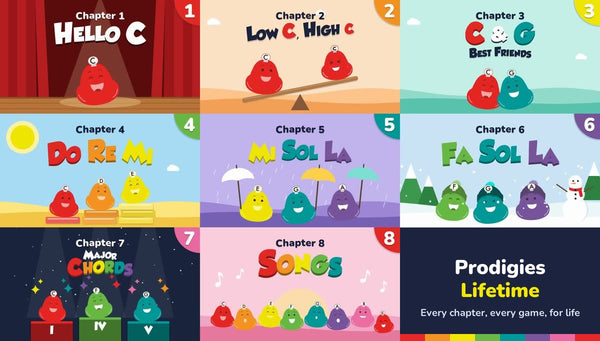
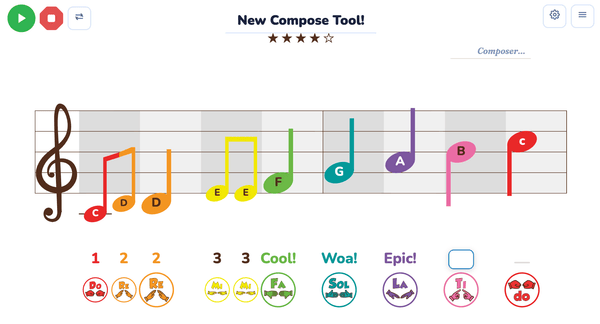
Full disclosure: we made this one. We built it because most ear training apps are made for college theory students, and we wanted something a three-year-old could play. Every note is its own colored bell (C is red, D is orange, E is yellow and so on), and there's no reading required, no ads and no login.
The Ear Training shelf is where to start:
- What Note Is It? starts with just three bells (C, D and E) and grows to all eight, with an option to add the black keys.
- Melody Memory: hear a short tune, play it back.
- What Interval Is It? climbs 16 levels. It starts with C up to every note of the C scale, then adds falling intervals, reading on the staff, both notes at once and a chromatic mix. Teachers can build any round, or pick a preset, in Practice Mode.
- Major or Minor?, What Chord Is It?, What Song Is It? and Instrument Detective round it out.
Two singing games, Bell Hopper and Sight Singer, listen through the microphone so kids can sing a note and watch the bell move. The sound is checked on the device and never recorded.
2. Absolute Pitch Checker (best for naming single notes)
Platforms: iPhone and iPad. Price: free with an ad banner; a $1.99 purchase removes the ads. Get Absolute Pitch Checker.
This is still our favorite app for quizzing single notes in a systematic way. Level 1 asks only C and D. Each level adds a note, then the black keys come in, and by level 12 you're naming all 12 notes across several octaves. You hear a tone and tap the letter name. It isn't designed for kids, but its slow, one-note-at-a-time ladder pairs perfectly with how we teach at Prodigies.
3. Functional Ear Trainer (best for hearing notes in a key)
Platforms: iPhone and iPad (App Store) and Android (Google Play). Price: free to download, with an optional Plus upgrade ($19.99 in the US App Store).
This app takes a different approach. Instead of drilling isolated intervals, it teaches you to hear each note's role inside a key, based on Alain Benbassat's method. Before each quiz note you hear a short chord progression that sets up the key. That can feel repetitive at first, but it burns the sound of "home" into your memory, and that pays off. We also love that you unlock the advanced levels by acing the easy ones, and that the custom quiz can label the keyboard with letter names or solfege.
4. Perfect Ear (best all-in-one for Android or iPhone)
Platforms: iPhone and iPad (App Store) and Android (Google Play). Price: free, with optional exercise packs and a Premium upgrade ($14.99 in the US App Store).
Perfect Ear mixes ear training with rhythm, sight reading and singing drills, and it has guided courses from beginner to advanced. It's a strong pick if you want one app for everything. One heads-up from our testing: some pitch quizzes ask you to tap letter names (with sharps) rather than piano keys, which can be harder for younger players.
5. Complete Ear Trainer (best step-by-step drills)
Platforms: iPhone and iPad (App Store), Android (Google Play) and the web through the developer's Complete Music Trainer. Price: the first chapter of each mode is free; the full version is a one-time $6.99.
Built like a video game: earn three stars in a drill to unlock the next one. It has 150+ drills over 28 chapters, plus an Easy mode with 50+ drills for beginners, and you don't need to read music on a staff. The free chapters are a great way to see if it clicks before you pay.
6. Earpeggio (best free app with no in-app purchases)
Platforms: iPhone and iPad (App Store) and Android (Google Play). Price: free, with no in-app purchases listed in either store as of November 2026.
Earpeggio has ten exercises, including interval and chord identification, chord progressions, melody dictation and rhythm dictation, plus tests and progress stats. It's best for older kids, teens and adults who already know a little theory.
7. Chet (best for teens and theory students)
Platforms: iPhone, iPad and Apple silicon Macs; there's no Android version. Price: free, with no in-app purchases listed. Get Chet.
Chet is one of the most polished ear training apps out there. It quizzes intervals, scales, arpeggios, chords, progressions, famous tunes and even atonal patterns, with call-and-response on a virtual piano, guitar or bass, real recorded musicians, MIDI keyboard support and global leaderboards. Most quizzes give you a starting pitch, so it's built for relative pitch. It's aimed at high school and college theory students rather than little kids. Signing in is optional, for tracking progress.
8. musictheory.net (best in a browser)
Platforms: any web browser at musictheory.net/exercises. Price: free online; the Tenuto app for iPhone and iPad ($4.99) adds offline versions.
Not an app store app, but too good to leave out, especially for classrooms and Chromebooks. The Ear Training section has keyboard, note, interval, scale and chord ear training, and teachers can use the Exercise Customizer to make a permanent link to a custom drill. No account needed.
9. EarForge (best game-style note levels)
Platforms: iPhone and iPad. Price: free lessons and quizzes; EarForge PRO ($3.99 a month or $19.99 a year) adds custom note and chord training. Get EarForge.
EarForge looks the most like a kids' game of the grown-up apps, with a 30-level notes program and chord lessons. Two notes: its last update was December 2024, and it offers Facebook, Google and Apple sign-in for tracking progress, so try the free lessons for a while before you subscribe.
10. Easy Perfect Pitch Training (best for advanced note naming)
Platforms: iPhone and iPad. Price: free, with no in-app purchases listed. Get Easy Perfect Pitch Training.
This one uses a piano keyboard and has Beginner, Normal, Hard and Super Hard modes. In our testing, even the easiest mode asks for all the notes, sharps included, right from the start, and the harder modes play two notes or full chords at once. So it's not for beginners and could frustrate them. For advanced learners who want a challenge, check it out.
Which ear training app for which age?
- Ages 3 to 6: Prodigies Music Games, with a grown-up nearby. Keep sessions short and celebrate every right answer.
- Ages 6 to 10: Prodigies Music Games (the interval and chord games), then Absolute Pitch Checker's early levels.
- Ages 10 and up: Functional Ear Trainer, Perfect Ear, Complete Ear Trainer or Earpeggio.
- Teens, college students and adults: Chet, Earpeggio and musictheory.net.
How to get the most out of an ear training app
- Five minutes beats an hour. A few minutes most days does more than one long session a week. It's like brushing your teeth for your ears.
- Start with fewer notes. Two or three notes, really learned, beat twelve notes guessed. Add one when the last one feels easy.
- Sing it back. After you name a note or interval, sing it. Your voice locks in what your ear just heard.
- Play it on a real instrument. Find the note on a piano, a xylophone or color-coded deskbells, so the sound has a place in your hands too.
- Mix screens with play. Apps are great for practice, and games away from the screen make the ideas stick. Here are our favorite music theory games for kids, offline and online.
And if your child doesn't get it on the tenth try, that's okay. Ears grow slowly and then all at once.
Where Prodigies fits in
Apps are a great supplement, and no matter how far along your Young Musician is, these should dovetail nicely with what we teach at Prodigies. Our own lessons are built on meaningful play with pitch during the critical window for auditory development: kids sing, hand-sign and play each note on its own colored bell until it feels like an old friend. Prodigies Music gives your child 1,000+ guided video lessons, color-coded songbooks and printables, made for ages 2 to 12 and built around play.
🎵 Start your membership at play.prodigies.com/join
Frequently asked questions
What is the best free ear training app?
For most beginners, Perfect Ear or Complete Ear Trainer on a phone, or musictheory.net in a browser. For hearing notes in a key, Functional Ear Trainer. For young kids, Prodigies Music Games. Earpeggio and Chet are free with no in-app purchases listed (as of November 2026).
What is the best free ear training app for Android?
Perfect Ear, Functional Ear Trainer, Complete Ear Trainer and Earpeggio are all on Google Play and free to start. Prodigies Music Games and musictheory.net also run in Chrome on an Android phone, tablet or Chromebook.
What is the best ear training app for kids?
For ages 3 to 8, look for an app with few notes at a time, pictures or colors instead of notation, and no ads. Prodigies Music Games was built for exactly that. Older kids can move on to Absolute Pitch Checker, Perfect Ear or Complete Ear Trainer.
Is Chet ear training free?
Yes. Chet is free in the App Store with no in-app purchases listed as of November 2026. It runs on iPhone, iPad and Apple silicon Macs. There's no Android version, so Android users can try Perfect Ear or Complete Ear Trainer instead.
Can you learn perfect pitch with an app?
An app can help anyone get better at naming notes, and relative pitch can be trained at any age. True absolute pitch is much more common in people who started music young, so the best time to play with real notes is early childhood, and apps like Absolute Pitch Checker work best as part of daily musical play.
How long should you practice ear training each day?
Five to ten minutes most days is plenty for kids, and a short daily habit usually beats a long weekly session for adults too. Stop while it's still fun.
Thanks for helping your Young Musician grow their musical ear. As always, happy musicing!
Start your child’s musical journey
Join 10,000+ families learning music the colorful, hands-on Prodigies way.
Explore Prodigies