Music Activities for Toddlers: 12 Ways to Start Music With Your Two-Year-Old
Quick answer: The best music activities for toddlers are short, silly and hands-on: two to five minutes at a time, with you playing right alongside. With a two-year-old, start here:
- Ring one color-coded bell, name it and sing it together.
- Have a freeze dance party.
- Make a simple drum or shaker and keep a steady beat.
- Do follow-the-directions songs like The Tooty Ta.
- Play "high and low" with your voice or two bells.
- Put on rich music (classical, jazz, music from around the world) during play.
Below: 12 toddler music activities with what each one builds, how to teach music to a two-year-old and answers to common questions.
Two-year-olds LOVE music. They bounce before you even press play, they sing the last word of every song, and they will ring a bell over and over (and over) again. That's not noise. That's a Young Musician getting started.
The good news is that music with a two-year-old doesn't look like a lesson at all. Nobody sits on a piano bench and nobody practices scales. It's you and your toddler singing, moving and playing together for a few happy minutes... and then doing it again tomorrow. Here are 12 music activities for toddlers you can start at home today, most of them free. If you'd like a guided path too, our music lessons for toddlers meet little ones right where they are.
What music looks like at age two
Around two, kids start joining in. They copy a clap, sing a word or two, and press a bell just to hear it again. Attention spans are short, so think in songs, not sessions: two to five minutes of focused play, once or twice a day, is plenty. If they wander off after one song, that's okay. They're still listening.
Want the bigger picture? Our guide to music for toddlers ages 1 to 3 walks through what changes from age one to age three.
How to teach music to a toddler
- Short and often beats long and rare. A song in the bath, a beat on the high chair tray and a bell before nap add up fast.
- One note at a time. Toddlers are in the critical window for auditory development, so give them chances to hear, name and play single notes. That's meaningful play with pitch.
- Play along, don't just press play. Your voice is your child's favorite instrument, even if you think you can't sing.
- Repeat, repeat, repeat. The same hello song every day is a feature, not a bug. Toddlers love knowing what comes next.
12 music activities for toddlers
1. DIY instruments (with supervision)
Almost anything can be an instrument. Bang paper-plate cymbals, make cardboard tube bells, or build a coffee-can drum. A pot and a wooden spoon count too. Play a steady beat together while you sing a favorite song, then let your toddler lead and you copy them.
Builds: steady beat, cause and effect, taking turns. (Watch small parts like beans, rice and bottle caps. They are a choking hazard, so seal shakers tightly and stay close.) More ideas: our 14 DIY musical instruments.
2. Color-coded bells
Press-to-play bells are a perfect first instrument for a two-year-old: one press, one clear note, no technique needed. Start with a single bell. Ring the red C bell, sing "Hello C," and let your toddler ring it back. Then play bell hide-and-seek: hide one bell under a blanket and ring it until they find it.
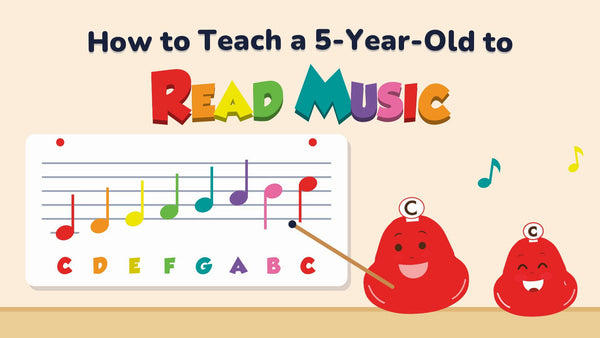
At Prodigies, every note has its own color: C is red (do), D is orange (re), E is yellow (mi), F is green (fa), G is teal (sol), A is purple (la), B is pink (ti), and high C is red again. Toddlers "read" colors long before letters, so the colors give them a way in. See our deskbells, or compare brands in our guide to the best bells for kids by age.
Builds: pitch, listening, colors and early note names.
3. Freeze dance
Hand your toddler an oversized shirt, a cape or a play scarf and have a dance party. Stop the music and everyone freezes. "The Freeze" by Greg & Steve is a classic for exactly this, and any song you can pause works too. For something calmer, dance along to the colorful Music Animation Machine videos by Stephen Malinowski (this one is Pachelbel's Canon in D), where every note is a shape you can watch.
Builds: listening, self-control and gross-motor skills.
4. A first classical music book
It's never too early to meet the composers. My First Classical Music Book by Genevieve Helsby (Naxos) introduces composers and instrument families with bright illustrations and comes with a CD of real recordings, from Mozart to Peter and the Wolf. It's written for ages 5 to 7, so at two, just look at the pictures and listen to a track together. It grows with your child.
Builds: listening, vocabulary, a love of "big" music.
5. Follow-the-directions songs
Action songs like Dr. Jean's The Tooty Ta and Head, Shoulders, Knees and Toes give little bodies a job to do while they listen. Start slow, then speed up when your toddler gets the moves. Expect giggles.
Builds: listening, rhythm, body awareness and following directions.
6. Flight of the Bumblebee (fast and slow)
Play Flight of the Bumblebee by Rimsky-Korsakov and have your toddler buzz around the room as fast as the music. Then put on something slow and let the bee get sleepy. There are more great bumblebee activity ideas here.
Builds: tempo (fast and slow) and moving to music.
7. Short music videos you play along with
Even at two, kids love Prodigies songs like C Major Pipes, Twinkle Twinkle, Sweet Beets ("beet, beet, cherry, beet") and Jingle Bells. Keep it to one or two short videos at a time, and sing, clap or ring a bell along with the screen. U.S. pediatric guidelines suggest about an hour a day, at most, of high-quality programs for ages 2 to 5, watched with a grown-up. A couple of music videos fits easily inside that. See how our video lessons work.
Builds: pitch, rhythm and singing, as long as you play along.
8. High-information music ("musical vegetables")
Nursery songs are great, but they're a bit like dessert. Rich, complex music (classical, jazz, music from around the world) is the musical vegetables. It stretches your toddler's idea of what music can be. Musician and YouTuber Rick Beato has talked about filling his son Dylan's earliest years with complex music, and Dylan grew up with perfect pitch. That's one family's story, not a study, but the idea is simple: the more rich music a young child hears, the more their ear has to work with. Play it during quiet time, in the car or at bedtime. Start with our top 10 classical pieces for kids.
Builds: a sense for pitch and harmony.
9. High and low
This one takes ten seconds and no gear. Sing a low "ohhh" and crouch down to the floor, then sing a high "eee" and reach for the sky. Then slide from low to high like a siren and stretch up as you go. If you have bells, ring the low C and the high C (both red) and let your toddler show you which one is which with their body.
Builds: hearing pitch direction, the very first step toward singing in tune.
10. Boomwhackers
Boomwhackers are colorful plastic tubes, each tuned to one note and color-matched to our bells. Tap one on the floor or your palm (not on a sibling) and play call and response: you tap a pattern, your toddler copies it. Most sets are labeled for ages 3 and up, so with a two-year-old, play together and keep it supervised. Our Boomwhackers for kids guide has easy songs for later.
Builds: rhythm, copying patterns and note colors.
11. Bells on a phone or tablet
Our free Prodigies Bells app turns a phone or tablet into a set of color-coded bells, which is handy in the car or at a restaurant. For a quick game, try Whack-a-Bell at games.prodigies.com: bells pop up, your toddler taps them, and each one plays its note. Sit together and sing the notes as they ring.
Builds: note colors and pitch, on the go.
12. Playtime Prodigies
When you want a guided path, Playtime Prodigies is our primer series made for around age two. It's a simpler, slower introduction to note names, numbers, colors and simple rhythms, with lots of meaningful exposure to pitch and easy practice that needs no instrument. It's included with a membership, and there's a printed Playtime Prodigies workbook if your toddler loves stickers and crayons.
Builds: a gentle start on the musical alphabet.
Fitting music into a toddler's day
You don't need a "music time." You need little moments, and you already have dozens:
- Bath time: splash to a steady beat, or sing high and low as the water goes up and down.
- Car rides: one classical piece, then one silly song you both sing.
- Clean-up: the same clean-up song every time works like magic.
- Getting dressed: sing about what you're doing. "Socks on, socks on, red socks on" counts as music.
- Bedtime: one slow lullaby, the same one each night.
Where to go next
Every child moves at their own speed, so borrow from the age below and the age above. For younger siblings, here are 13 music activities for one-year-olds. When your toddler is ready for more, see music lessons for 3-year-olds. For extra games to add to this list, try our toddler music games, and when they're a little older, music activities for preschoolers.
When you want a guided path, Prodigies Music gives your child 1,000+ guided video lessons, color-coded songbooks and printables, made for ages 2 to 12 and built around play. Start with Playtime Prodigies and grow from there.
🎵 Start your membership at play.prodigies.com/join
Frequently asked questions
Can a 2-year-old take music lessons?
Yes, as musical play. At two, a music lesson means a grown-up and a toddler singing, moving and playing simple instruments together for a few minutes at a time. Short, playful activities like one-note bell songs, freeze dance and follow-the-directions songs build real skills: steady beat, pitch and listening.
How do you teach music to a toddler?
Keep it short, playful and repeated. Sing all day long, keep a steady beat with claps and drums, play one note at a time on easy instruments like press-to-play bells, and play along with your toddler instead of just pressing play. Two to five minutes once or twice a day is plenty.
What are good music activities for toddlers?
Freeze dance, DIY drums and shakers, color-coded bell games, action songs like The Tooty Ta, fast-and-slow movement to Flight of the Bumblebee, high-and-low pitch games, and listening to rich music like classical and jazz during play are all great music activities for toddlers.
What is the best first instrument for a two-year-old?
Something that makes a nice sound on the first try and is hard to break: press-to-play bells, egg shakers or a hand drum. Color-coded bells add real notes, so your toddler can start playing with pitch. Boomwhackers are usually labeled for ages 3 and up, so use them together at two.
How much screen time is okay for toddler music?
Keep it short and do it together. U.S. pediatric guidelines suggest no more than about an hour a day of high-quality programs for ages 2 to 5, watched with a grown-up. One or two short music videos, with you singing and playing along, fits well inside that.
Thanks for making music with your little one. As always, happy musicing!
Start your child’s musical journey
Join 10,000+ families learning music the colorful, hands-on Prodigies way.
Explore Prodigies