Fixed Do or Movable Do? How Prodigies Teaches Both
Quick answer: In fixed do, do is always the note C, re is always D, and so on, so the syllables work like note names. In movable do, do is the home note of whatever key you're in, so the syllables describe each note's job in the key. Both are real, respected systems:
- Fixed do is standard in much of Europe and Latin America and in the Dalcroze approach.
- Movable do is standard in the US and UK and in the Kodály method.
- Fixed do is great for learning the notes themselves (and absolute pitch).
- Movable do is great for hearing how notes relate (relative pitch).
- In the key of C, the two systems are identical.
At Prodigies, young kids start in fixed do (do is always C, our red bell), we build relative pitch with scale degrees and chords, and we've added movable-do songs for teachers and older kids.
Few questions get music teachers going like this one. Ask a room of us "fixed do or movable do?" and you'd better have snacks, because it's going to be a while. I grew up on movable do. Then I built a music program for preschoolers and chose fixed do. So I've argued both sides of this debate, mostly with myself.
This post explains both systems fairly, who uses which and why, the minor-key question, and exactly how Prodigies handles it (including what we don't do).
What is fixed do?
In fixed do, each solfège syllable belongs to one pitch, no matter what key a song is in. Do is C, re is D, mi is E, fa is F, sol is G, la is A and ti is B (many countries say "si" instead of "ti"). In a lot of the world, these syllables simply ARE the note names. A French or Italian musician says "sol" where an American says "G."
Think of fixed do like a street address. The house at 5 Sol Street is always at 5 Sol Street, whoever is visiting.
What is movable do?
In movable do, do is the home note (the tonic) of the key. In C major, do is C. In G major, do moves to G, re is A, mi is B, and so on. The syllables don't name the pitch. They name its job in the key, the same way scale degrees 1 through 7 do.
If fixed do is a street address, movable do is directions from home: "two doors down from our house." Move to a new neighborhood and the directions still work.
Modern movable do owes a lot to the tonic sol-fa system that John Curwen developed in 19th-century England, the same system that gave us the solfège hand signs. Kodály teachers in Hungary later adopted it, which is a big reason it's so common in American elementary music rooms.
One song, two systems
Here's "Twinkle, Twinkle, Little Star" in the key of G (the notes are G G D D E E D):
- Fixed do: sol sol re re mi mi re
- Movable do: do do sol sol la la sol
Now sing it in C (C C G G A A G). In fixed do it's do do sol sol la la sol. In movable do it's... do do sol sol la la sol. Same thing. In the key of C, the two systems agree completely, and they only part ways when the key changes.
Who uses fixed do, and who uses movable do?
- Fixed do is the usual system in France, Italy, Spain, Portugal, much of Latin America and much of Eastern Europe, including Russia. It's also the system of Dalcroze teaching (the Swiss teacher Émile Jaques-Dalcroze developed it in Geneva). In Japan, fixed do spread widely through private music schools for young children, even though school music officially used movable do.
- Movable do is the usual system in the United States, the UK and other English-speaking countries, in Germany (where it's called Tonika-Do) and in Hungary. It's the system of the Kodály method.
So there's no single "right" answer worldwide. There are two traditions, each with millions of fine musicians.
Pros and cons of each system
| Fixed do | Movable do | |
|---|---|---|
| What do means | Always C | The home note of the key |
| Best at | Learning the actual notes; reading in any key without converting; supporting absolute pitch | Hearing how notes relate; sight-singing; transposing; hearing chord function |
| Harder at | Showing how a melody works in its key (do isn't always home) | Reading in keys with lots of sharps or flats; kids must find do first |
| Sharps and flats | Often the same syllable (C and C-sharp can both be "do") | Changed syllables for chromatic notes (fi, si, te and so on) |
| Who uses it | Much of Europe and Latin America; Dalcroze | US, UK, Germany, Hungary; Kodály |
| Fits well with | Color-coded instruments, piano, early childhood | Singing, choirs, ear training, aural skills classes |
What about minor keys? La-based vs. do-based minor
Movable-do teachers have their own friendly argument about minor keys. Take A minor:
- La-based minor: the minor scale starts on la, so A minor is la ti do re mi fa sol la. Minor shares its syllables with its relative major (C major). This is the Kodály approach, and it keeps reading easy because the syllables never change.
- Do-based minor: do stays the home note, so A minor is do re me fa sol le te do, with lowered syllables for the minor notes. Many college aural skills programs prefer this, because do always means "home" and the syllables match the scale degrees and chord functions.
In fixed do, the question never comes up. A is la in every key, major or minor.
The absolute pitch question
Here's the big reason fixed do comes up with young children. Absolute pitch (often called perfect pitch) is the ability to name or sing a note with no reference note. It's rare, and research suggests it's much easier to develop with early training. In one study, Japanese researcher Ayako Sakakibara trained 24 children ages 2 to 6 to identify chords by name, and every child who stayed with the training developed absolute pitch (two stopped before the end). Put simply, early childhood is a special window for pitch memory.
Notice what that study used, though: consistent names for consistent sounds. That's the case for fixed do with little ones. If the red bell is always C and C is always do, a three-year-old hears, sings and sees the same thing every time.
The other side matters too. Psychologist Ken'ichi Miyazaki found that some people with absolute pitch actually struggle with relative pitch tasks in unfamiliar keys, and he recommended that children who start lessons early also get careful relative pitch training. In other words, absolute pitch is wonderful, but every musician needs relative pitch. Movable-do teachers are right about that.
"Doesn't Prodigies only use fixed do?"
If you've searched for reviews of Prodigies, you may have seen this one. Google's AI summary of whether Prodigies is worth it lists, as a downside, that we rely on a fixed C scale rather than movable do. It's a fair description of where we start, and a teacher who lives in movable do has every reason to ask about it. It just isn't the whole picture. Here's what we actually do.
- Young kids start in fixed do. Do is always C, always red, always the same bell. Our Level 1 chapters (Hello C, Low C High C, C and G Best Friends, Do Re Mi, Mi Sol La, Fa Sol La, Major Chords and Songs) build the C major scale one note at a time. For a two- to six-year-old, consistency is everything, and we want to give them the best shot at the pitch memory early childhood makes possible.
- Most early songs are in C, where both systems match. A Kodály kid and a Prodigies kid sing the same syllables on "Hot Cross Buns" in C. Nothing to unlearn.
- We teach relative pitch with numbers and chords. Kids learn scale degrees (1 through 8) and the I, IV and V chords, which train the same "how notes relate" ear that movable do trains.
- We've added movable do for teachers and older kids. Our Movable Do collection takes classic Do Re Mi songs into the keys of F and G, notated with movable-do hand signs and scale degrees, and some of our song studies include both fixed-do and movable-do performances.
What we don't do: our core path is not a movable-do curriculum, and we won't pretend it is. If your classroom runs on movable do, you'll find that the C major material lines up perfectly, and the Movable Do collection helps when you change keys.
Which should you use?
If you teach preschool or teach your own young kids at home: fixed do (or simply letter names plus colors) keeps things consistent while kids learn what each note sounds like. Don't stress about it. Singing every day matters far more than which system you pick.
If you teach elementary general music or choir in the US: movable do is probably what your curriculum, your colleagues and your kids' future choir directors use. Start in C, where both systems agree, and when kids move to F or G, let do move with them.
If you teach piano or instruments: fixed do lines up with the keys and strings kids actually press. Add scale degrees so they also hear how the notes relate.
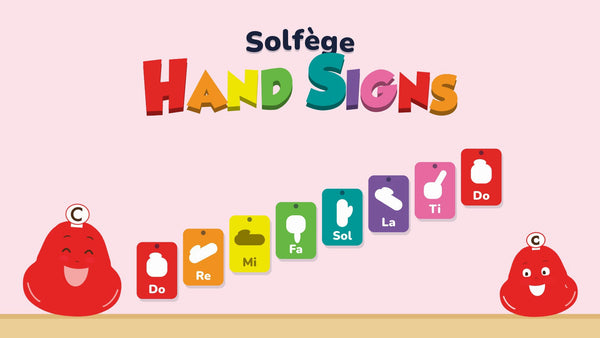
The honest answer is that strong musicians end up understanding both. A child who knows what C sounds like AND knows what "home" feels like in any key has the best of both worlds. Using hand signs? They work with either system. Here's our guide to solfège hand signs, with a free printable poster.
How Prodigies brings it together
Prodigies kids sing, hand-sign and play every note, on color-coded deskbells, so the note they hear, see and play all match. Prodigies Music gives your child 1,000+ guided video lessons, color-coded songbooks and printables, made for ages 2 to 12 and built around play. For schools, Prodigies PK-5 is a sequenced curriculum for preschool through grade 5, and the Movable Do collection is included for teachers who want it.
🎵 Start your membership at play.prodigies.com/join
Frequently asked questions
What is the difference between fixed do and movable do?
In fixed do, do is always C, so each syllable names one pitch. In movable do, do is the home note of the key, so each syllable names a note's role in the key. In C major, the two systems are exactly the same.
Is the Kodály method fixed do or movable do?
Movable do. Kodály teachers treat do as the home note of whatever key a song is in, and most use la-based minor. The Dalcroze approach, by contrast, uses fixed do.
Which countries use fixed do?
Fixed do is the usual system in France, Italy, Spain, Portugal, much of Latin America and much of Eastern Europe, including Russia, where the solfège syllables are the everyday note names. Movable do is more common in the US, the UK, Germany and Hungary.
Is fixed do better for perfect pitch?
It can help, because fixed do gives each pitch one consistent name, which supports pitch memory in young children. But absolute pitch also depends on early, regular exposure, and every musician still needs relative pitch, which movable do and scale degrees train well.
Does Prodigies use fixed do or movable do?
Both, in different places. Young children start in fixed do, with do always on C and the red bell, and build relative pitch through scale degrees and I, IV and V chords. Prodigies also includes a Movable Do collection with classic songs in F and G major, notated with movable-do hand signs and scale degrees.
What is la-based minor?
It's a movable-do approach where a minor scale starts on la (la ti do re mi fa sol la), so minor shares its syllables with its relative major. In do-based minor, do stays home and the minor notes get lowered syllables (do re me fa sol le te do).
Whichever do you choose, thanks for filling the world with more singing. As always, happy musicing!
Start your child’s musical journey
Join 10,000+ families learning music the colorful, hands-on Prodigies way.
Explore Prodigies