16 Kindergarten Music Activities (Fun Games & Ideas)
Quick answer: The best kindergarten music activities are short, active games that teach one musical idea at a time. Favorites that work in any classroom or living room:
- Singing games like "Doggie, Doggie, Where's Your Bone?"
- Pass the beat: keep a steady beat while passing a beanbag around the circle.
- Read rhythms with words, like "beet, beet, cherry, beet."
- Freeze on opposites: loud and soft, fast and slow, high and low.
- Play a real song by color on bells or Boomwhackers.
- Write a four-note song and perform it for the class.
- Act out the animals in "The Carnival of the Animals."
- Play a quick music game on a tablet or the classroom screen.
All 16 are below, with what you need, how to play and what each one teaches, plus a sample 20-minute kindergarten music class.
Kindergarten is a magic year for music. Five- and six-year-olds can sing in tune, keep a steady beat, follow a game with rules, and they're just starting to read. So they're ready for more than "shake the shaker"... but they still need to MOVE every few minutes.
These kindergarten music activities are the ones I'd reach for in a music class, a regular kindergarten classroom or a homeschool. Each one teaches one real musical idea, and none of them need a music degree. Most are free.
Singing games for kindergarten
1. Doggie, Doggie, Where's Your Bone?
You need: A "bone" (a block, a beanbag, anything small).
How to play: One child, the doggie, sits in the middle with eyes closed. You quietly hand the bone to another child, who hides it behind their back. The class sings: "Doggie, doggie, where's your bone? Somebody stole it from your home." The child with the bone sings alone: "I have your bone!" The doggie guesses who sang.
What it teaches: Singing alone with confidence, and listening for a voice. The song uses just two notes (Sol and Mi), so it's a perfect first song for solfege hand signs.
2. Charlie Over the Ocean
You need: A circle and some room to run.
How to play: The leader walks around the outside of the circle singing each line, and the class echoes it back: "Charlie over the ocean / Charlie over the sea / Charlie caught a blackbird / Can't catch me!" On "me," the leader taps someone, who chases them around the circle.
What it teaches: Echo singing (call and response), matching pitch, and waiting for the right moment. Kids will beg to play it again.
3. Solfege Hello Song
You need: Your voice and your hands.
How to play: Sing "Hel-lo, ev-ery-bo-dy" on Sol, Mi, Sol, Sol, Mi, Mi using the hand signs, and have the class echo you. Then sing each child's name on Sol and Mi, and let them sing it back.
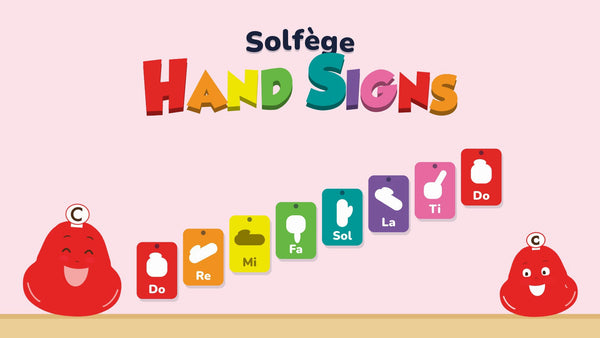
What it teaches: Pitch matching and the first two solfege hand signs. Our free solfege singing video shows every hand sign. For more, see these singing games you can play with students.
Steady beat and rhythm activities
4. Pass the Beat
You need: One beanbag (or a ball), and any song with a strong beat.
How to play: Sit in a circle. Pass the beanbag to the next person on every beat of the song: pass, pass, pass, pass. When the song stops, whoever is holding the beanbag picks the next song or leads the next round.
What it teaches: Steady beat, the foundation for everything rhythmic. It's harder than it looks, and that's the fun. For more ideas, here are our steady beat activities.
5. Sweet Beets Rhythm Reading
You need: Four cards with fruit pictures, or simple drawings on the board.
How to play: Each fruit is a rhythm you say and clap. "Beet" is one sound on one beat. "Cher-ry" is two quick sounds on one beat. Line up four cards ("beet, beet, cher-ry, beet") and have the class say it, clap it, then play it on a drum. Mix up the cards and go again.
What it teaches: Reading real rhythms (quarter notes and eighth notes) with words kids already know. That's how we teach rhythm with our Sweet Beets fruits.
6. Copycat Body Percussion
You need: Nothing.
How to play: Clap, pat or stomp a short pattern (pat, pat, clap, clap) and have the class copy it right back. Let kids take turns being the leader.
What it teaches: Rhythm memory, listening and focus. It's also the best attention-getter I know. A quick clap pattern quiets a room faster than "shh!"
Music games for kindergarten
7. Freeze on Opposites
You need: A drum, or any music you can control.
How to play: Play loud, and kids stomp like giants. Play soft, and they tiptoe. Play fast, they run in place. Play slow, they move like sloths. When the music stops, everybody freezes.
What it teaches: Dynamics (loud and soft) and tempo (fast and slow), which are two of the big ideas in kindergarten music standards.
8. High or Low?
You need: Two bells (low C and high C), a xylophone, or your voice.
How to play: Play a high note, and kids reach for the sky. Play a low note, and they touch their toes. Then play two notes in a row and ask: did it go up or down?
What it teaches: Pitch direction, the first step toward singing in tune and reading notes on a staff.
9. Hot and Cold Singing
You need: A small object to hide.
How to play: One child leaves the room (or covers their eyes) while you hide the object. When they come back, the class sings a song they all know. They sing louder as the seeker gets closer, and softer as they move away.
What it teaches: Dynamics, used for a real purpose. Kids get very good at "a little louder" very quickly.
10. Quick Music Games on a Screen
You need: A tablet, a computer or the classroom screen.
How to play: Our free Prodigies music games are built around one skill each. In Bell Run, the red C bell runs and jumps to collect notes. In Treble Trouble, the bells blast their colors at notes flying across the staff. Play one round as a class, with kids calling out the colors.
What it teaches: Reading notes, hearing pitch and keeping a beat, wrapped in a game. Every game has free levels to try.

Instrument activities for kindergarten
11. Play a Song by Color
You need: Color-coded deskbells, Boomwhackers or a glockenspiel, and color-coded sheet music.
How to play: Start with three notes: red C, orange D and yellow E. "Hot Cross Buns" goes yellow, orange, red. Give each child one bell, point to the colors on the music, and the bell that matches rings. Then try "Mary Had a Little Lamb," which adds one teal G.
What it teaches: Reading music from left to right, matching symbols to sounds, and playing together as an ensemble. Kindergartners read colors years before they read notes. Our color-coded sheet music is made for exactly this.

12. Boomwhacker Chords
You need: A C major set of Boomwhackers.
How to play: Split the class into three color teams: red C, yellow E and teal G. When you hold up a card with all three colors, everybody plays at once. That's a C major chord! Then sing "Row, Row, Row Your Boat" while everyone plays the chord on the strong beats.
What it teaches: Harmony (notes sounding together), teamwork and watching a conductor. Our Boomwhackers for kids guide has more songs.
13. Write a Four-Note Song
You need: Paper and crayons in the note colors, or Prodigies Compose (free in any web browser).
How to play: Each child picks four colors and draws four circles in a row. That's their song! Play it on the bells for the class. In Compose, kids drag bells onto a staff, and each note appears in its color. Then they press play and hear it.
What it teaches: Composing, and the big idea that written music is just a way to remember sounds. Kids are SO proud to hear their own song played.
14. DIY Instrument Band
You need: Recycled containers, rice or beans, rubber bands, tape.
How to play: Build shakers, drums and rubber-band guitars, then sort them: which ones are loud, which are soft, which ring and which thud? Finish with a class parade. Here are 14 DIY musical instruments to try.
What it teaches: How instruments make sound (shaking, hitting, plucking), plus a little science.
Listening activities for kindergarten
15. The Carnival of the Animals
You need: A recording of Saint-Saëns' "The Carnival of the Animals."
How to play: Play one short movement without saying the title. Kids move the way the music sounds. Is it heavy and slow, like "The Elephant"? Royal and proud, like "The Lion"? Floaty and sparkly, like "Aquarium"? Then reveal the animal.
What it teaches: Active listening, and describing music with words like heavy, light, fast and slow. For more, see our top 10 classical pieces for kids.
16. Peter and the Wolf Instrument Hunt
You need: A recording of Prokofiev's "Peter and the Wolf" and pictures of the instruments.
How to play: Every character has its own instrument: the bird is a flute, the duck is an oboe, the cat is a clarinet, Grandfather is a bassoon, the wolf is the French horns, and Peter is the strings. Hold up a picture when you hear each one.
What it teaches: Instrument families and tone color, the idea that every instrument has its own voice.
A 20-minute kindergarten music class (sample lesson plan)
- Solfege Hello Song (2 minutes). Sol, Mi, and everybody's name.
- Copycat Body Percussion (2 minutes). Wakes up ears and bodies.
- Pass the Beat (3 minutes). Steady beat with a beanbag.
- New skill (5 minutes). Sweet Beets rhythm cards, or High or Low.
- Play (5 minutes). A song by color on bells or Boomwhackers.
- Game (2 minutes). Doggie, Doggie or Freeze on Opposites.
- Goodbye (1 minute). The same goodbye song every time.
Want a whole year of these, ready to teach? Grab our free K-5 music lesson plans.
Tips for kindergarten music teachers
- Switch every 3 to 5 minutes. Alternate sitting and moving activities, and you'll rarely lose the room.
- Same opening, same closing. A hello song and a goodbye song make music time feel safe and predictable.
- Teach one idea at a time. Loud and soft this week, fast and slow next week.
- Let kids lead. A five-year-old "conductor" gets the whole class watching.
- Use color. Color-coded notes let every child play real music on day one, readers and pre-readers alike.
If you teach music to a whole school, Prodigies PK-5 is our standards-aligned elementary music curriculum, with lesson plans and video lessons for every grade from pre-K through 5th.
Kindergarten music activities at home
Every activity above works at home with one child and a grown-up. Five minutes a day goes a long way: a steady-beat game in the car, a song on the bells after dinner, a piece of classical music at bedtime. If your kindergartner is ready to start reading notes, here's how to teach a 5-year-old to read music. Have a younger one too? Try our 15 music activities for preschoolers.
If you'd like a plan to follow, Prodigies Music gives your family 1,000+ guided video lessons, color-coded songbooks and printables, made for ages 2 to 12. Kids sing, hand-sign and play real songs from the very first lesson.
🎵 Start your membership at play.prodigies.com/join
Frequently asked questions
What music activities are good for kindergarten?
Short, active games that teach one idea at a time: singing games like Doggie, Doggie, Where's Your Bone, steady beat games like Pass the Beat, freeze games for loud and soft or fast and slow, playing songs by color on bells or Boomwhackers, and listening to music like "The Carnival of the Animals."
What should kindergarten students learn in music?
Most kindergarten music standards focus on steady beat, singing in tune, high and low, loud and soft, fast and slow, and responding to music through movement. Kids also start to read simple rhythms and play simple instruments.
How long should a kindergarten music class be?
About 20 to 30 minutes, switching activities every 3 to 5 minutes. At home, 5 to 15 minutes a day is plenty.
What are some easy music games for kindergarten?
Freeze on Opposites, Pass the Beat, Hot and Cold Singing, Copycat Body Percussion and High or Low all need little or nothing to play. For screen time, our free Prodigies music games teach notes, pitch and beat.
What instruments are best for kindergarten?
Color-coded deskbells, Boomwhackers, a glockenspiel or xylophone, and simple rhythm instruments like hand drums, rhythm sticks and shakers. Color-coded instruments let kindergartners play real songs before they can read traditional notes.
Thanks for bringing music to your kindergartners. As always, happy musicing!
Start your child’s musical journey
Join 10,000+ families learning music the colorful, hands-on Prodigies way.
Explore Prodigies