Best Music Apps for Preschoolers (2026): 8 Honest Picks
Quick answer: The best music apps for preschoolers have no ads, keep purchases behind a grown-up gate, and get kids singing, moving or playing real notes instead of just tapping. Our honest picks for 2026, by what you want:
- Free music and movement: Kindermusik or Music Together.
- Learning the notes by ear: Prodigies Music Games for Kids.
- Making music with no wrong answers: Bandimal or Chrome Music Lab.
- Calm, low-stimulation play: Pok Pok.
- A free all-in-one learning app with sing-alongs: Khan Academy Kids.
- Writing a first song together: Prodigies Compose & Perform.
Below: ages, prices, platforms, ads and privacy notes for each, how to choose, and a screen-time note.
Search for music apps for little kids and you'll find a lot of lists from 2021, a lot of toy pianos and a lot of apps that have quietly disappeared from the App Store. So I went through the current stores myself (November 2026) and checked every app below: the name it goes by now, what it costs, where it runs, what it does with your child's data and what it actually teaches.
Full disclosure: two of these apps are ours. I've tried to describe them the same way I describe everyone else's, including who they're NOT for.
The 8 best music apps for preschoolers (2026)
These aren't ranked. Each one is the best at something different, so pick the one that matches what you want for your child.
1. Kindermusik: best free music-and-movement app
Kindermusik has run music classes for babies and young kids for decades, and its free app brings a slice of that home: hundreds of kid songs, playlists for routines like bedtime, instrument sounds to explore, instrument guessing games, narrated stories and activity videos.
- Ages: made by a company whose classes run from newborn to age 7.
- Price: free, with a free account.
- Platforms: iPhone, iPad and Android.
- Ads and privacy: no ads. Its Apple privacy label says the developer collects no data from the app.
- What it teaches: listening, steady beat, instrument sounds and a love of singing together.
2. Music Together: best for singing together as a family
If your family takes a Music Together class, this app is a must. If you don't, it's still a lovely free sampler: 12 songs come preloaded (including the "Hello Song"), with on-screen lyrics and a free singalong storybook.
- Ages: Music Together classes are for families with kids from birth through age 8.
- Price: free with 12 songs. Enrolled families unlock each semester's collection with the code in their songbook, and individual songs and storybooks are sold in the app.
- Platforms: iPhone, iPad and Android.
- Ads and privacy: no ads that we could find. Apple's label lists analytics, coarse location, email and device ID, used for analytics and not linked to your identity.
- What it teaches: singing, rhythm and the habit of making music as a family. It's a listening and sing-along app more than a game.
3. Prodigies Music Games for Kids: best for learning the notes by ear
This is our app, so take my enthusiasm with a grain of salt. It's 30+ music games built on eight colored bells, where every note has its own color (red is always C, orange is D, yellow is E). Kids hear a note, sing it and ring it, game after game, in games like What Note Is It, Melody Memory, Bell Train, Treble Trouble and Make a Sweet Beat. Two of them, Bell Hopper and Sight Singer, listen through the microphone so your child can sing a note and watch the bell hop.
- Ages: listed by Apple in the Kids category for ages 5 and under.
- Price: the first levels of every game are free. A subscription unlocks everything for $6.99 a month or $49.99 a year (the yearly plan starts with a 7-day free trial).
- Platforms: iPhone and iPad. It isn't on Google Play yet, so on Android tablets and Chromebooks, play it in a web browser at games.prodigies.com.
- Ads and privacy: no ads and no tracking. A parental gate sits in front of every purchase and every link out of the app, and the singing games check sound on the device without recording it. Apple's label lists purchase history, email and gameplay data, used to run the app.
- What it teaches: pitch and listening, note names, singing in tune, rhythm and early music reading.
- Not for: families who want open-ended play with no levels. Try Bandimal or Pok Pok for that.
4. Bandimal: best one-time-price music maker
Bandimal, from the Finnish studio YATATOY, turns animals into a band. Kids build a drum loop, swipe through animals to change instruments, tap in a melody and add silly effects. Everything sounds good, which is the whole point.
- Ages: Common Sense Media says 3+. Apple files it under ages 6 to 8.
- Price: $4.99 once. No subscription, no in-app purchases.
- Platforms: iPhone and iPad. We couldn't find an Android version.
- Ads and privacy: no ads, works offline, and its Apple privacy label says no data is collected.
- What it teaches: loops, steady beat, layering sounds and composing by ear.
5. Pok Pok: best calm, low-stimulation play
Pok Pok is a playroom of open-ended "toys" with soft sounds and slow animations, and a few of them are musical: Musical Blobs, a Sequencer for making beats and a Radio for dancing and singing along. Music is a slice of Pok Pok, not the whole pie, but if your child gets wound up by loud, flashy apps, this is the gentle one.
- Ages: 2 to 8, per the developer.
- Price: a subscription with a free trial. The US App Store lists monthly plans from $6.99, yearly plans from $45.99 and a $89.99 lifetime option.
- Platforms: iPhone, iPad and Android.
- Ads and privacy: no ads and COPPA compliant, per the developer. Apple's label lists purchase history and usage data.
- What it teaches: cause and effect, patterns, beat and free exploration of sound.
6. Chrome Music Lab: best free, no-download option
Chrome Music Lab is a free set of music experiments from Google that runs in any web browser. Song Maker lets you build a tune on a colorful grid and play it back, and the other experiments explore rhythm, melody and sound. No account, no download, nothing to buy.
- Ages: no age given. Preschoolers do best with a grown-up driving and the child choosing.
- Price: free.
- Platforms: any web browser, including tablets and Chromebooks.
- Ads and privacy: no ads and no sign-in. It falls under Google's privacy policy.
- What it teaches: high and low, patterns, rhythm and simple composing. Teachers use it in classrooms too.
7. Khan Academy Kids: best free all-rounder (with some music)
Khan Academy Kids isn't a music app. It's a free early-learning app for reading, math and more, and music shows up as sing-along and dance videos from Super Simple Songs. I'm including it because it's free, ad-free and already used by millions of kids, and those songs are a fine way to get a preschooler singing.
- Ages: 2 to 8.
- Price: free. No ads and no subscriptions, from a nonprofit.
- Platforms: iPhone, iPad and Android.
- Ads and privacy: no ads. Apple's label lists usage data, IDs and contact info, not linked to your identity.
- What it teaches (music): singing and moving along with songs. For notes, pitch or rhythm, pair it with one of the apps above.
8. Prodigies Compose & Perform: best for writing a first song together
Also ours. Compose is a music notebook: tap a note onto the staff and hear it ring on a real bell, with every note wearing its color. Then hit play and watch the music scroll along. Honestly, most 3-year-olds won't use this on their own. It shines when a grown-up and a 4- or 5-year-old sit together and write "our song," then play it on real bells.
- Ages: rated 4+. Best for about 5 and up, or younger with a grown-up.
- Price: writing, playback, sharing a link and the song library are free. A subscription ($9.99 a month or $69.99 a year, with a 7-day free trial on yearly) adds saving, printing, more time signatures and Perform mode. Prodigies members sign in and get it all.
- Platforms: iPhone and iPad, or any web browser at compose.prodigies.com.
- Ads and privacy: no ads. The song library is written by other users (mostly music teachers), so every song passes a language filter and has a Report button.
- What it teaches: that music can be written down, note names and colors, rhythm values and composing.
The 8 apps at a glance
| App | Ages | Price | Platforms | Ads | Main skill |
|---|---|---|---|---|---|
| Kindermusik | 0 to 7 (classes) | Free | iOS, Android | None | Listening, instruments |
| Music Together | 0 to 8 (classes) | Free, 12 songs | iOS, Android | None found | Family singing |
| Prodigies Music Games for Kids | 5 and under (Apple) | Free levels, then $6.99/mo or $49.99/yr | iOS, web | None | Pitch, note names, singing |
| Bandimal | 3+ (Common Sense) | $4.99 once | iOS | None | Loops and beat |
| Pok Pok | 2 to 8 | Subscription | iOS, Android | None | Calm sound play |
| Chrome Music Lab | Any, with a grown-up | Free | Web | None | Patterns, composing |
| Khan Academy Kids | 2 to 8 | Free | iOS, Android | None | Sing-alongs |
| Prodigies Compose & Perform | 5+ (or younger with you) | Free core, then $9.99/mo or $69.99/yr | iOS, web | None | Writing songs |
Prices are from the US App Store and the developers' own pages in November 2026. They change, so check before you buy.
How to choose a music app for your preschooler
Here's the checklist I use. If an app fails the first two, I skip it, no matter how cute it is.
- No ads. Lots of free "baby piano" apps pay their bills with ads. Ads interrupt the music and train little thumbs to tap away. Every app on this list is ad-free.
- A grown-up gate. Purchases and links out of the app should sit behind a parental gate. On iPhone and iPad, apps in Apple's Kids category have to follow stricter rules on ads, data and links.
- Real notes, not just noise. Does the app use real pitches, steady beats and real songs? Tapping a cartoon cow that moos is fun. Matching a sung note to a bell is music.
- It gets them singing or moving. The voice is a child's first instrument. The best apps get kids singing back, clapping or dancing, not just watching.
- It connects to the real world. Look for an app that leads somewhere off the screen: a song you sing in the car, a beat you clap at dinner, a note you play on a real instrument.
- It's made for their age. A 3-year-old needs big buttons, no reading and no timers. Save the note-reading drills and the piano apps with scores for later.
- Price you understand. A one-time price is simple. A subscription is fine if there's a free tier or a trial, and if you know how to cancel (on Apple devices, that's in your Apple ID settings).
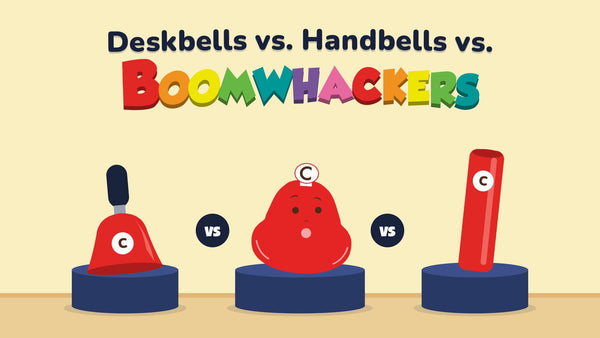
That fifth point is the one I care about most. At Prodigies, the colors in our apps are the same colors on our deskbells, Boomwhackers and ChromaNotes instruments, so the red C your child finds on the iPad is the red C they ring in their hands. If you're thinking about a first instrument, our guide to the best bells for kids by age compares a bunch of options, including other brands.
A quick note on screen time
Music apps are still screens, so a little perspective helps. The World Health Organization's guidelines for young children say sedentary screen time isn't recommended for 1-year-olds, and that kids aged 2 to 4 should have no more than one hour a day (less is better). In January 2026, the American Academy of Pediatrics published new guidance that moves away from a single number and focuses on how apps are designed and how families use them together, with a family media plan and shared family devices.
In other words, the best music app is one you use WITH your child, for a short stretch, and then you put the tablet down and keep singing. Ten minutes of a note game, then five minutes of ringing the real bells, beats an hour of tapping alone every time.
And if you'd rather skip screens for now, that's okay too. Singing in the car, clapping fruit rhythms ("beet, beet, cherry, beet") and banging on pots and pans all count. Here are some music lessons for preschoolers you can start at home, no app needed.
Where Prodigies fits
The two Prodigies apps above are the playground. The lessons are the classroom. Prodigies Music gives your child 1,000+ guided video lessons, color-coded songbooks and printables, made for ages 2 to 12 and built around play. Kids sing, hand-sign and play their way through chapters like Hello C and Do Re Mi, and members get Compose unlocked when they sign in.
🎵 Start your membership at play.prodigies.com/join
Frequently asked questions
What is the best free music app for preschoolers?
For free with no ads, Kindermusik and Music Together are the strongest music-first picks, Chrome Music Lab is great in a web browser, and Khan Academy Kids adds sing-along songs inside a full learning app. Prodigies Music Games for Kids and Prodigies Compose & Perform are free to start, with paid upgrades.
Are music apps good for 3-year-olds?
They can be, if the app has no ads, uses real notes and songs, and gets your child singing, moving or playing along. Use them for short stretches with a grown-up nearby, and connect them to real music off the screen.
Which music apps teach note names to preschoolers?
Prodigies Music Games for Kids teaches note names through color (red is C, orange is D, yellow is E) and by ear, and Prodigies Compose & Perform shows those colored notes on a real staff. Most other preschool apps focus on beat, instrument sounds and singing rather than note names.
Do any of these apps work offline?
Bandimal works with no internet connection, and Prodigies Music Games for Kids and Prodigies Compose & Perform both work offline once installed. Check each app's listing before a long car ride.
Are the Prodigies apps on Android?
Not on Google Play yet. On Android tablets and Chromebooks, you can play Prodigies Games at games.prodigies.com and use Compose at compose.prodigies.com in a web browser.
Can a music app replace music lessons?
Not on its own. An app is great practice and a great hook, but young kids learn music best by singing, moving and playing real instruments with a grown-up. Think of the app as the snack, not the meal.
Thanks for making music part of your little one's day. As always, happy musicing!
Start your child’s musical journey
Join 10,000+ families learning music the colorful, hands-on Prodigies way.
Explore Prodigies