Kindergarten Music at Home: A 12-Week Plan for Parents
Quick answer: You can teach kindergarten music at home in 15 to 20 minutes, three times a week, with your voice, your hands and a few bells. Teach one idea at a time, in this order:
- Weeks 1 to 3: steady beat, short and long sounds, and rests.
- Weeks 4 to 6: high and low, plus quarter and eighth notes.
- Weeks 7 to 9: sol-mi singing with hand signs, and C and G together.
- Weeks 10 to 12: Do Re Mi and your child's first bell songs, ending with a family concert.
Below: the full week-by-week plan, what a 15-minute session looks like, and how it lines up with Prodigies Music Level 1.
If you're homeschooling a kindergartner (or just want more music in your house than the car radio), you might be wondering where to even start. Do you need a piano? Lessons? A music degree? Nope. Five- and six-year-olds are ready to learn real music skills, and the best teacher they'll ever have is the grown-up who sings with them every week. YOU can do this.
This is the plan I'd hand a parent who asked me, "What should we actually do, week by week?" It's 12 weeks long. Each week has one big idea, three short sessions, a song and a simple way to know it's working. If you'd like more games to mix in, our list of 16 kindergarten music activities pairs well with it.
What kindergartners learn in music
School music standards are a good map for home, too. The National Core Arts Standards for kindergarten ask kids to explore beat and melodic contour (the up-and-down shape of a tune), and to notice contrasts like high and low, loud and soft, and same and different. In other words: feel the beat, hear the shape of a melody, and notice when music changes. You can look up your own state's kindergarten music standards for free in the Music Standards Hub.
At Prodigies, we add one more thing to the list: meaningful play with pitch during the critical window for auditory development. Kids this age soak up sounds the way they soak up language. So this plan gets your child singing on pitch, hand-signing and playing real notes, not just shaking a shaker.
What you need
- Your voice. It doesn't need to be pretty. It needs to be there.
- Something to tap. A drum, a pot and a wooden spoon, or two hands on a table.
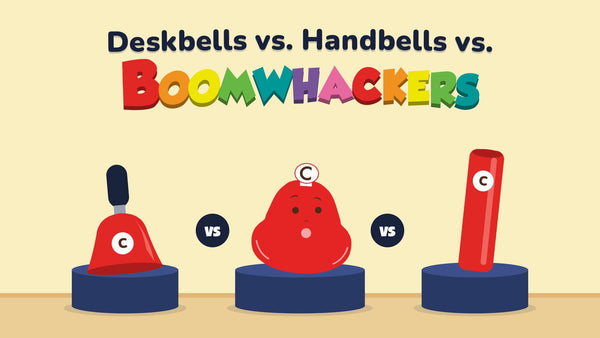
- Color-coded bells, if you can. Eight bells from C to high C, one color per note: C red, D orange, E yellow, F green, G teal, A purple, B pink, high C red again. Our deskbells collection is one option, and a color-coded xylophone or Boomwhackers work too. No bells yet? Every week below still works with voices and body percussion.
- Paper and crayons in the same colors, for drawing rhythms and songs.
How a 15-minute session works
Every session follows the same rhythm, so your child knows what's coming:
- Hello song (1 minute). The same one every time. Sing "Hel-lo, ev-ery-bo-dy" and let your child sing it back.
- Warm-up (3 minutes). A beat game or a quick echo from last week.
- New idea (5 minutes). The one thing this week is about.
- Play (5 minutes). The week's song, sung and then played.
- Goodbye (1 minute). Same goodbye song, every time.
Three of these a week is plenty. Twenty minutes is the top end for most five-year-olds, and stopping while they still want more is a feature, not a bug. If a week doesn't stick, repeat it. If they don't get it on the tenth try, that's okay.
The 12-week kindergarten music plan
Weeks 1 to 3: Beat, short and long, and rests
Week 1: Find the steady beat. The beat is music's heartbeat, the pulse you tap your foot to. Put your child's hand on their chest to feel their own heartbeat, then march around the room to a favorite song, one step per beat. Try it with a fast song and a slow song. Tap the beat on a pot while you sing "Twinkle, Twinkle, Little Star." Check: Can they march or tap along to a song without speeding up? For more beat games, see our steady beat activities.
Week 2: Short and long sounds. Meet two Sweet Beets fruit rhythms. "Beet" is a short sound that lasts one beat (a quarter note). "Mel-on" is a long sound you hold for two beats (a half note). Say and clap "beet, beet, beet, beet," then "mel-on, mel-on," holding each melon. Then play just one bell, red C, short and long. Draw them: a small red dot for beet, a long red line for melon. Check: Can they clap a beet pattern and hold a melon?
Week 3: Rests and "Shh." Silence is part of music, too. A rest is a beat where you make no sound, and kids love saying "shh" for it. Clap "beet, beet, shh, shh," with a finger to your lips on each shh. Take turns: you make a four-beat pattern with beets and shh's, and your child echoes it. Check: Can they stay silent on the shh, and come back in on time?
Weeks 4 to 6: High and low, quarter and eighth notes
Week 4: High and low. Here's the big one for this age. Sing a "woo" that slides from low to high, and reach from your toes to the sky as it goes. Then play a low note and a high note on any instrument. High note, arms up. Low note, touch your toes. Kids often mix up "high" with "loud," so play a quiet high note and a loud low note on purpose. Check: Can they tell high from low, even when the volume changes?
Week 5: Low C, high C. If you have bells, put low C (red) on the left and high C (also red) on the right. Play low C with the left hand, high C with the right, back and forth, and sing "low" and "high" as you play. Make up a song: "Birds fly high, worms crawl low." Check: Can they find the high C by ear when you play one of the two behind your back?
Week 6: Beet and cherry. Add the cherry. "Cher-ry" is two quick sounds in one beat (two eighth notes). Say and clap "beet, beet, cherry, beet." Make cards with a beet or a cherry on each, line up four, and read them left to right like a sentence. Then mix them up and read again. Check: Can they read a four-card rhythm without your help?
Weeks 7 to 9: Sol-mi, C and G, and expression
Week 7: Sol-mi and the first hand signs. Sol-mi is the two-note "cuck-oo" pattern you hear in tons of children's songs and playground chants. Learn two solfege hand signs: sol is a flat hand facing your chest, held at about shoulder height, and mi is a flat hand facing down, held a little lower. Sing "See Saw" and "Snail, Snail" with the signs, moving your hand as the tune moves. Then sing your child's name on sol and mi and let them sing it back. Our free solfege singing video shows every sign. Check: Can they sing sol-mi back to you and show the two signs?
Week 8: C and G, best friends. At Prodigies, we tend to use fixed do with young kids, so do is always C and sol is always G. Play red C and teal G together, then again and again, on the beat. That's a bordun, a simple two-note accompaniment that sounds great under lots of kids' songs. Play C and G together on every beat while you both sing "The Wheels on the Bus." Your kindergartner is now accompanying a song. Make a big deal of it. Check: Can they keep playing C and G on the beat while you sing?
Week 9: Loud and soft, fast and slow. Take any song they know well and play with it. Sing it like a giant (loud), like a mouse (soft), like a cheetah (fast) and like a sloth (slow). Then let your child pick how the next round should sound and you follow. Musicians call this expression, and it's what makes music feel like something. Check: Can they change their singing or playing on purpose when you ask?
Weeks 10 to 12: Do Re Mi and first bell songs
Week 10: Do, Re, Mi. Meet three neighbor notes: C (red, do), D (orange, re) and E (yellow, mi). Learn the do hand sign (a closed fist) and the re sign (a flat hand angled up), and add the mi you already know. Sing up and down: do, re, mi, mi, re, do. Then play the same notes on the bells. Notes next to each other are called steps. Check: Can they sing and sign do, re, mi?
Week 11: First bell songs. "Hot Cross Buns" is yellow, orange, red: mi, re, do. Write it in colored circles, point to each one, and let your child play it. Then try "Mary Had a Little Lamb," which uses mostly C, D and E, with a teal G on the third line. Sing it, sign it, then play it. Want more songs written in colors? Our color-coded sheet music is made for exactly this. Check: Can they play "Hot Cross Buns" while reading the colors?
Week 12: Compose and perform. Let your child write their own four-note song: four colored circles in a row. Play it, name it, and play it again. Then put on a family concert with everything from the last 12 weeks: a beat march, a Sweet Beets rhythm, a sol-mi song, Hot Cross Buns and the brand-new original. Grandparents on video count as an audience. Check: Did they perform something for someone? That's the whole goal.
How this plan lines up with Prodigies Music
If you'd like videos to teach alongside you, this plan follows the same order as Prodigies Music Level 1. Here's the honest map:
| Plan weeks | Big idea | Prodigies Music Level 1 |
|---|---|---|
| 1 to 3 | Beat, short and long, rests | Chapter 1, Hello C, plus the Sweet Beets rhythm lessons |
| 4 to 6 | High and low, beet and cherry | Chapter 2, Low C, High C |
| 7 to 9 | Sol-mi, C and G together | Chapter 3, C and G Best Friends (sol-mi songs also live in our Kodály and Sol-Mi songs collection) |
| 10 to 12 | Do Re Mi, first songs | Chapter 4, Do Re Mi |
One thing to know: in Prodigies Music, each of those chapters is about eight weeks of material. So this 12-week plan is a quick tour of the first four chapters, not the whole thing. If your child loves a week, stay there and watch more of that chapter. If your kindergartner is already six and all of this feels easy, Chapter 5, Mi Sol La, is a good place to jump in. After that come Fa Sol La and Major Chords and Songs.
Prodigies Music gives your child 1,000+ guided video lessons, color-coded songbooks and printables, made for ages 2 to 12 and built around play. Ms. Sam and I teach the lessons on camera with the same colored bells, so your child can sing, hand-sign and play along while you sit right next to them. For a quick game between sessions, our Prodigies music games have free levels to try, like What Note Is It? (name the bell you hear) and Make a Sweet Beat (build a beat from scratch).
🎵 Start your membership at play.prodigies.com/join
Tips for teaching music at home
- Same time, same place. After breakfast or before bath works better than "whenever we get to it."
- Sing first, play second. If a child can sing a tune, they can play it. The voice is the first instrument.
- Let them lead. Your child makes up the rhythm, you echo it. Being the teacher is a HUGE motivator.
- Keep the bells out. Bells on a shelf get played. Bells in a closet don't.
- Don't fix every wrong note. Notice what went right first. A happy musician practices more.
Working on singing in tune? Start with teaching your kids to sing in tune. Ready for notes on a staff? Here's how to teach a 5-year-old to read music. Looking for a full year with siblings of different ages? See our homeschool music curriculum.
Frequently asked questions
How do I teach my kindergartner music at home?
Keep it short and regular: about 15 to 20 minutes, three times a week. Teach one idea at a time, in order: steady beat, short and long sounds, rests, high and low, simple rhythms, sol-mi singing, and then first songs on color-coded bells. Sing everything before you play it, and repeat a week whenever your child needs more time.
What should a kindergartner learn in music?
Most kindergarten music standards focus on feeling a steady beat, hearing the up-and-down shape of a melody, and noticing contrasts like high and low, loud and soft, and fast and slow. By the end of kindergarten, many kids can also read simple rhythms, sing a few songs in tune and play a short melody on a simple instrument.
How long should kindergarten music lessons be at home?
About 15 to 20 minutes per session is plenty for a five- or six-year-old. Short sessions a few times a week build more skill than one long session, and stopping while your child still wants more keeps music fun.
Do I need to play an instrument to teach music at home?
No. Your voice and your hands are enough for every week of this plan. Color-coded bells make it easier to play real songs, because your child only needs to match colors, and video lessons can model the singing and playing for both of you.
What is the best first instrument for a kindergartner?
A simple pitched instrument with color-coded notes works best, like deskbells, Boomwhackers or a glockenspiel. Your child can find each note by color, play it with one motion, and start playing real melodies like "Hot Cross Buns" right away.
What is sol-mi?
Sol-mi is the two-note pattern at the heart of many children's songs and playground chants, like "See Saw." Singing it with solfege hand signs is often the very first step in teaching kids to sing in tune and read melodies.
Thanks for making music a part of your child's week. As always, happy musicing!
Start your child’s musical journey
Join 10,000+ families learning music the colorful, hands-on Prodigies way.
Explore Prodigies